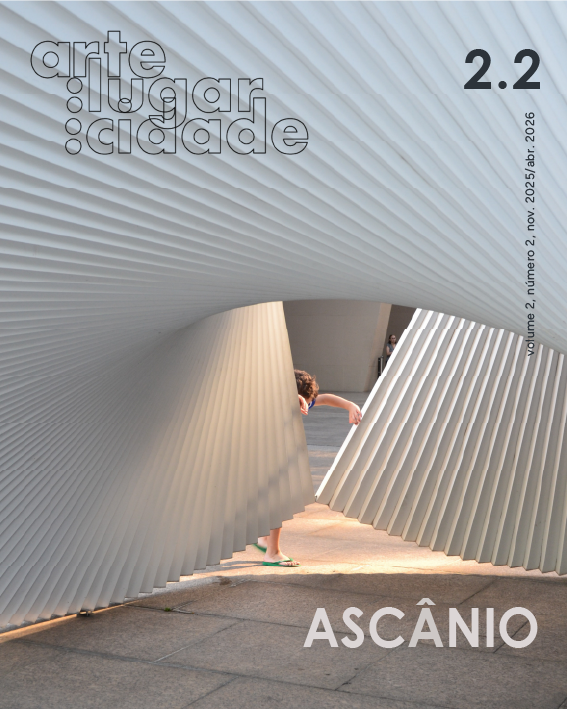
Call me by any name you wish, but call me Marylin's skirt: the public sculpture by Ascânio MMM
DOI:
https://doi.org/10.22409/arte.lugar.cidade.v2i2.69647Keywords:
public art, invisibility, popular appropriation, Ascânio MMM, Rio de JaneiroAbstract
In this article, we seek to advance reflections on the use of public spaces in contemporary cities, grounded in theories of public art, critical urbanism, and public policy, with the aim of considering the processes of aestheticization of urban life and gentrification of areas in these cities. We also consider other more optimistic possibilities that point to public art as a generator of singularities, capable of leveraging citizens' self-esteem and promoting population engagement. In these reflections, we seek to analyze the relationships that are established around Ascânio MMM's sculpture Módulo Rio (Module 8.4), installed in the outdoor access area of a corporate building in the city of Rio de Janeiro.
References
Alvarez, R. (2021). Redentor: a biografia do Cristo de braços abertos, ilustre morador do Corcovado, orgulho do Brasil, maravilha do mundo. Globo Livros.
Assmann, A. (2022). (In)visible Monuments. What Makes Monuments Controversial?. In U. Capdepón, & S. Dornhof (Eds.), Contested Urban Spaces. Palgrave Macmillan Memory Studies. Palgrave Macmillan. https://doi.org/10.1007/978-3-030-87505-3_2
Brant, F., & Nascimento, M. (2018). Nos bailes da vida. Nascimento Edições Musicais, Sony Music.
Buren, D. (1979). A função do ateliê [Fonction de l’atelier]. In U. Loock (Ed.), Anarquitectura de Andre a Zittel (pp. 48-53). Público / Fundação de Serralves.
Bingham-Hall, J. (2015). Public Art as a Function of Urbanism. In The Everyday Practice of Public Art (pp. 161-176). Routledge.
Ceron, I. P. (Org.). (2021). Galeria de Artistas: Centro Empresarial Rio 1983-1990. FGV Conhecimento.
Conduru, T. (2013). Rio de Janeiro, capital das artes. história, histórias, 1(1), 26-34.
https://pdfs.semanticscholar.org/0d07/1af618a5341eaa541160ee4da0ed482acdb5.pdf .
Deutsche, R. (1992). Art and Public Space: Questions of Democracy. Social Text, (33), 34-53.
Elsabagh, H. A. E., Bashandy, S. Y. H., Abd Elaziz, N. M., & Abd El Aziz, N. A. (2022). The impact of 3d public art on improving visual image and identity of urban spaces. Journal of Urban Research, 46(1), 76-102.
Giumbelli, E. (2008). A modernidade do Cristo Redentor. Dados, 51, 75-105.
Gullar, F. (1977). Teoria do Não-Objeto. In A. A. Amaral (Org.). Projeto construtivo brasileiro na arte: 1950-1962 (pp. 85-94). Museu de Arte Moderna do Rio de Janeiro; Pinacoteca do Estado de São Paulo.
Hall, T. (2014). Art and Urban Change: Public art in Urban Regeneration. In Cultural Geography in Practice (pp. 221-237). Routledge.
Herkenhoff, P. (2012). Ascanio MMM: Poética da razão. Bei Comunicação.
Herzog, C. S. (2012). Arquitetura da festa: arte pública e neoconcretismo no Rio de Janeiro (Dissertação de mestrado não-publicada). Pontifícia Universidade Católica do Rio de Janeiro, Departamento de História.
Khan, Y. S. (2017). Enlightening the world: the creation of the Statue of Liberty. Cornell University Press.
Kwon, M. (2002). Public Art and Urban Identities. Blog Transversal Texts.
https://transversal.at/transversal/0102/kwon/en
Lipovetsky, G., & Serroy, J. (2015). A estetização do mundo - viver na era do capitalismo artista. Companhia das Letras.
Mathews, V. (2010). Aestheticizing Space: Art, Gentrification and the City. Geography Compass, 4(6), 660-675.
Mikulay, J. G. (2011). Another Look at La Grande Vitesse. Public Art Dialogue, 1(1), 5-23.
Musil, R. (1987). Monuments. In Posthumous papers of a living author (P. Wortsman,Trans.). Eridanos Press.
Nance, K. (2004, 14 julho). The Bean’s Bone of Contention; What’s in a Name? Disagreements Swirl around Kapoor Piece in Millennium Park (64). Chicago Sun-Times.
Oliveira, L. S. (2022). Ascânio MMM: a cidade como lugar da escultura. In S. Furegatti, T. S. Bassani, & A. Sequeira (Eds.), Arte pública no Brasil: convergências e dissensos (pp. 23-34). Instituto de Artes, Unicamp.
Pritchard, S. (2020). The Artwashing of Gentrification and Social Cleansing. In The Handbook of Displacement (pp. 179-198). Springer International Publishing.
Sacco, P. L., Tartari, M., Ferilli, G., & Tavano Blessi, G. (2019). Gentrification as Space Domestication. The High Line Art Case. Urban Geography, 40(4), 529-554.
Sansi, R. (2020). The Idle Goddess: Notes about Post-relational Anthropology and Art. In An Anthropology of Contemporary Art (pp. 196-210). Routledge.
Sansi, R. (2015). Public Disorder and the Politics of Aesthetics in Barcelona. Journal of Material Culture, 20(4), 429-442.
Santino, C. (2024, 25 agosto). All About Marilyn Monroe's Iconic White Dress (and the Behind-the-Scenes Drama It Caused). People.
https://people.com/style/marilyn-monroe-iconic-white-dress-details/
Senie, H. F. (2003). Responsible criticism: evaluating public art. Sculpture, 22(10), 44-49.
Senie, H. F. (2002). The Tilted Arc controversy: Dangerous precedent?. U. of Minnesota Press.
Serra, R. (2001). The Tilted Arc Controversy. Cardozo Arts & Ent. LJ, 19, 39.
Sharp, J., Pollock, V., & Paddison, R. (2020). Just Art for a Just City: Public Art and Social Inclusion in Urban Regeneration. In Culture-led Urban Regeneration (pp. 156-178). Routledge.
Sutherland, C. (2003). The statue of liberty. Barnes & Noble Publishing.
Tartari, M., Pedrini, S., & Sacco, P. L. (2022). Urban “Beautification” and its Discontents: The Erosion of Urban Commons in Milan. European Planning Studies, 30(4), 643-662.
Ward, J. (2011). Cloud Gate: Challenging Reproducibility. In C. Eisner, & M. Vicinus (Eds.), Originality, imitation, and plagiarism: teaching writing in the digital age (64-76). The University of Michigan Press. https://library.oapen.org/bitstream/handle/20.500.12657/24007/1006126.pdf#page=73
Downloads
Published
Issue
Section
License
Copyright (c) 2025 Luiz Sérgio de Oliveira

This work is licensed under a Creative Commons Attribution-NonCommercial-NoDerivatives 4.0 International License.