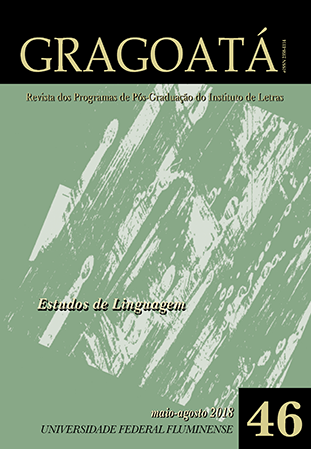
The Preferred Argument Structure of 'unattached' Temporal Circumstantial Hypotactic Clauses in 'when memes'
DOI:
https://doi.org/10.22409/gragoata.v23i46.33588Keywords:
Temporal Circumstantial Hypotactic Clauses. Unattached Clauses. When memes. Preferred Argument Structure (PAS).Abstract
We aim to analyze the Preferred Argument Structure - PAS (DU BOIS, 1987) of unattached Temporal Circumstantial Hypotactic Clauses in when memes, collected from Google search site and Instagram social network. We adopted the following methodological procedures: we collected 100 clauses, divided according to the verb type (verbs of two arguments (V2), existential verbs of an argument (V1e) and non-existential verbs of an argument (V1~e)) and encoded them according to the variables verbal tense and mood; order of constituents; semantic and syntactic verb type; manifestation, position and informational status of the subject of transitive and intransitive verbs and the object of transitive verbs. The results indicated the following general features: SV(O) ordering and presence of state or action verbs (with stronger tendency for the latter) in the Present of the Indicative. In relation to verbal typologies, the following features were detected, partially confirming the PAS: Subject of V2 = [pronominal, pre, given]; Object of V2 = [lexical, post, new]; Subject of V1e = [lexical/ pronominal, pre, given/new]; Subject of V1~e = [lexical/pronominal, pre, new]. We found that these constructions constitute a special type considering the subject manifestation. Therefore, we understand that, in these constructs, V2 verbs tend to present pronominalized and given interaction participants; on the other hand, V1e and V1~e tend to focus on participants of the interaction or external to it (pronominal or lexical, given or new), although V1~e has a greater tendency to introduce new subjects. Moreover, we verified the frequency of these unattached clauses in memes.
---
Downloads
Downloads
Published
Issue
Section
License
Authors who publish in Gragoatá agree to the following terms:
The authors retain the rights and give the journal the right to the first publication, simultaneously subject to a Creative Commons license CC-BY-NC 4.0, which allows sharing by third parties with due mention to the author and the first publication by Gragoatá.
Authors may enter into additional and separate contractual arrangements for the non-exclusive distribution of the published version of the work (for example, posting it in an institutional repository or publishing it in a book), with recognition of its initial publication in Gragoatá.

Gragoatá is licensed under a Creative Commons - Attribution-NonCommercial 4.0 International.