
More than just forming anthropologists, practicing anthropology: memories, socialization and academic practice based on a professional experience with Roberto Kant de Lima
DOI:
https://doi.org/10.22409/antropolitica2026.v1.i1.a72973Keywords:
Roberto Kant de Lima, Anthropology, Anthropological theory.Abstract
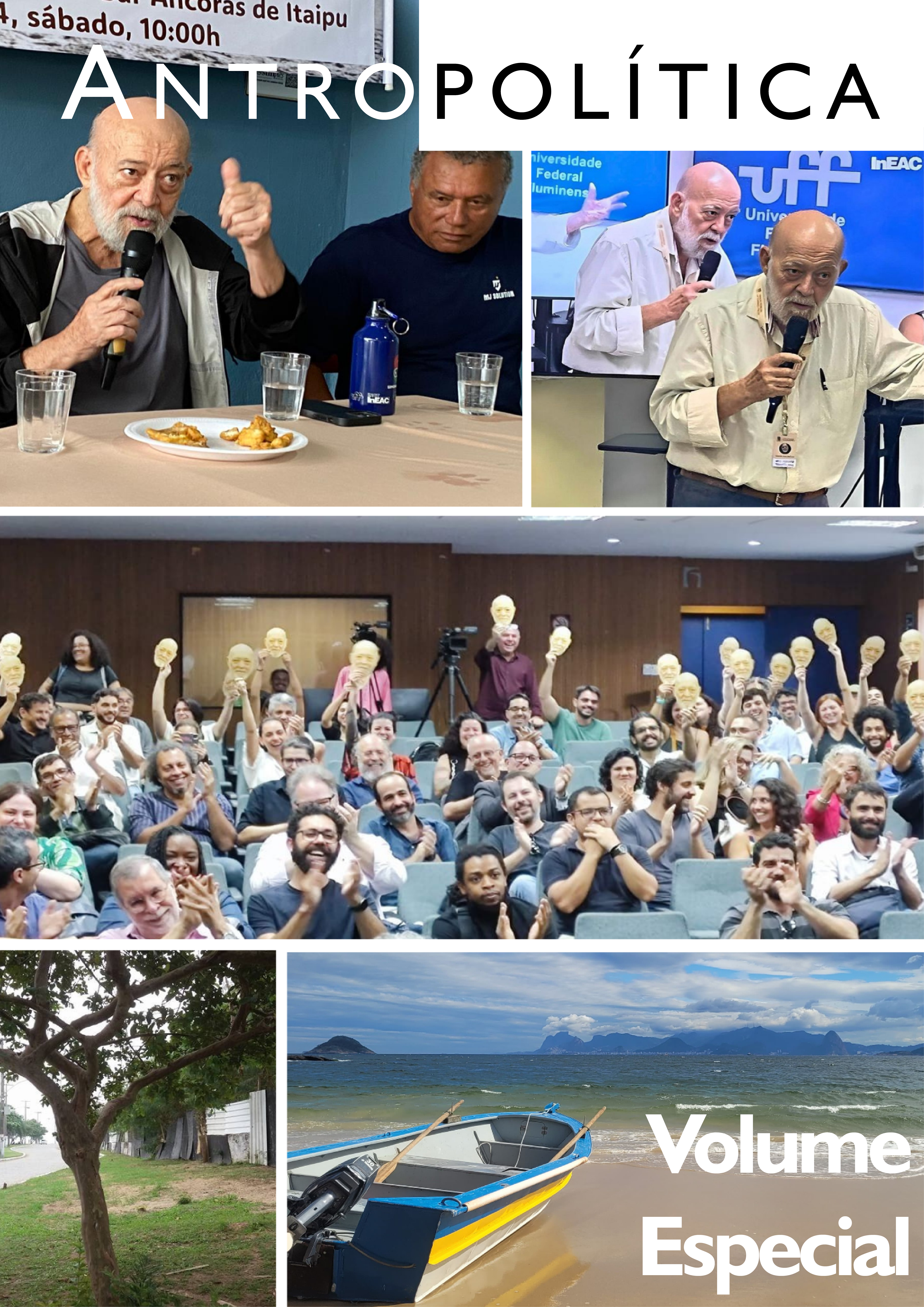
This article takes as its starting point a loss and a collective grieving process to reflect on an anthropological formative experience lived under the guidance and coordination of the anthropologist, professor, and researcher Roberto Kant de Lima, who passed away on May 19, 2025. Without intending to offer a memoriam tribute, we take as our starting point the shared memories we have as students, advisees, colleagues, and friends to understand the work of an anthropologist-professor-administrator whose pedagogical practice integrated intellectual training, research, institutional work, administration, affection, and collective production. By reconstructing lived experiences, conversations, and lessons, we seek to understand how a particular way of practicing anthropology was transmitted beyond texts, classes, and meetings—through practices, relationships, and ways of being and acting within anthropology and the academic field. In this sense, we have attempted to ethnographically document the paths we have traveled alongside Kant in an educational endeavor inevitably shaped by the interaction among students at different stages of their education, professors, staff, and research interlocutors, by research practices and academic administration, and by the transmission of a Brazilian social thought understood and developed through participation in a specific academic way of life. Memories are thus taken as a methodological key to reflecting on his contribution to anthropological training in Brazil and to recognizing, in the practices we carry out today, the traces of a way of doing anthropology learned through shared experiences, projects, his traditional Monday meetings, conversations, conflicts, decisions, doubts, and mistakes. In revisiting the question posed by Kant himself— “How does one become an anthropologist in Brazil?”—we reflect on what one learns from a professor beyond courses, reading lists, concepts, and hierarchies, based on the description and denaturalization of his own practices.
Downloads
References
30 ANOS NUFEP - 28 de agosto de 2024. Youtube InEAC, [S. l.], 12 set. 2024. Disponível em: https://www.youtube.com/watch?v=qbzOUF7QtIA. Acesso em: 1 ago. 2026.
CASTRO FARIA, Luiz de. Antropologia: escritos exumados 3: lições de um praticante. Niterói: EdUFF, 2006.
KANT DE LIMA, Roberto. A antropologia da academia: quando os índios somos nós. 3. ed. rev. ampl. Niterói: EdUFF, 2011 [1985].
KANT DE LIMA, Roberto; e alunos. Memórias das reuniões de segunda-feira, de 1994 a 2025. Niterói: NUFEP (sala 205, bloco O): NEPEAC, 1994 a 2025.
KANT DE LIMA, Roberto. A presença de Castro Faria na Universidade Federal Fluminense (1993-1998): uma perspectiva afetivo-institucional. In: CASTRO FARIA, Luiz de. Antropologia: escritos exumados 3: lições de um praticante. Niterói: EdUFF, 2006. p.29-46
KANT DE LIMA, Roberto; MOTA, Fabio Reis; BRAMA, Leonardo. ‘Confusion of horizons? with unwanted Others: Frustrations, results and effects of ethnographic practices in the realm of justice and public safety. Vibrant, v. 21, p. 1-19, 2024. Disponível em: https://doi.org/10.1590/1809-43412024v21e211008. Acesso em: 27 ago. 2026.
KANT DE LIMA, Roberto. Prefácio: A antropologia com o direito e com a segurança pública, no Brasil, em perspectiva comparada. In: CARDOSO DE OLIVEIRA, Luís Roberto. Desigualdade de Tratamento e Cidadania no Brasil: Pontos, contrapontos e dilemas da igualdade cidadã. Rio de Janeiro: Autografia, 2025. v. 111. p. 13-39.
MESA de Encerramento: Para Cima e Para o Alto! - XI Seminário Internacional do INCT INEAC. Youtube InEAC, [S. l.], 14 nov. 2024. Disponível em: https://www.youtube.com/live/cheH5YxGvgQ?si=SacCeEaELLVpy5SP. Acesso em: 1 ago. 2026.
MESA: Redes e parcerias para além do Brasil. XII SEMINÁRIO INTERNACIONAL DO INCT INEAC. Youtube InEAC, [S. l.], 17 nov. 2025. Disponível em: https://www.youtube.com/live/dQJu263iGlM?si=lb9UPj0TsS6mages. Acesso em: 1 ago. 2026.
NADER, Laura. Up the anthropologist: perspectives gained from studying up. In: HYMES, Dell (ed.). Reinventing anthropology. New York: Pantheon Books, 1972. p. 284-311.
SEGURANÇA Pública é tema de entrevista com Roberto Kant de Lima - Professor é o idealizador do primeiro curso de bacharelado na área. Globo Universidade, [S. l.], 9 maio. 2012. Disponível em: https://redeglobo.globo.com/globouniversidade/noticia/2012/05/seguranca-publica-e-tema-de-entrevista-com-roberto-kant-de-lima.html. Acesso em: 1 ago. 2026.
SILVA, Edilson Márcio Almeida da Silva. Quanto vale a liberdade? A antropologia da academia, 40 anos depois. Antropolítica, Revista Contemporânea de Antropologia, Niterói, v. 57, n. 2, e67010, 2025. Disponível em: https://doi.org/10.22409/antropolitica2025.v57.i1.a67010. Acesso em: 27 ago. 2026.
Downloads
Published
Issue
Section
License
Copyright (c) 2026 Paloma Monteiro, Natália Barroso Brandão

This work is licensed under a Creative Commons Attribution 4.0 International License.
O conteúdo da revista Antropolítica, em sua totalidade, está licenciado sob uma Licença Creative Commons de atribuição CC-BY (http://creativecommons.org/licenses/by/4.0/deed.pt).
De acordo com a licença os seguintes direitos são concedidos:
- Compartilhar – copiar e redistribuir o material em qualquer suporte ou formato;
- Adaptar – remixar, transformar, e criar a partir do material para qualquer fim, mesmo que comercial;
- O licenciante não pode revogar estes direitos desde que você respeite os termos da licença.
De acordo com os termos seguintes:
- Atribuição – Você deve informar o crédito adequado, fornecer um link para a licença e indicar se alterações foram feitas. Você deve fazê-lo em qualquer maneira razoável, mas de modo algo que sugira que o licenciante o apoia ou aprova seu uso;
- Sem restrições adicionais — Você não pode aplicar termos jurídicos ou medidas de caráter tecnológico que restrinjam legalmente outros de fazerem algo que a licença permita.