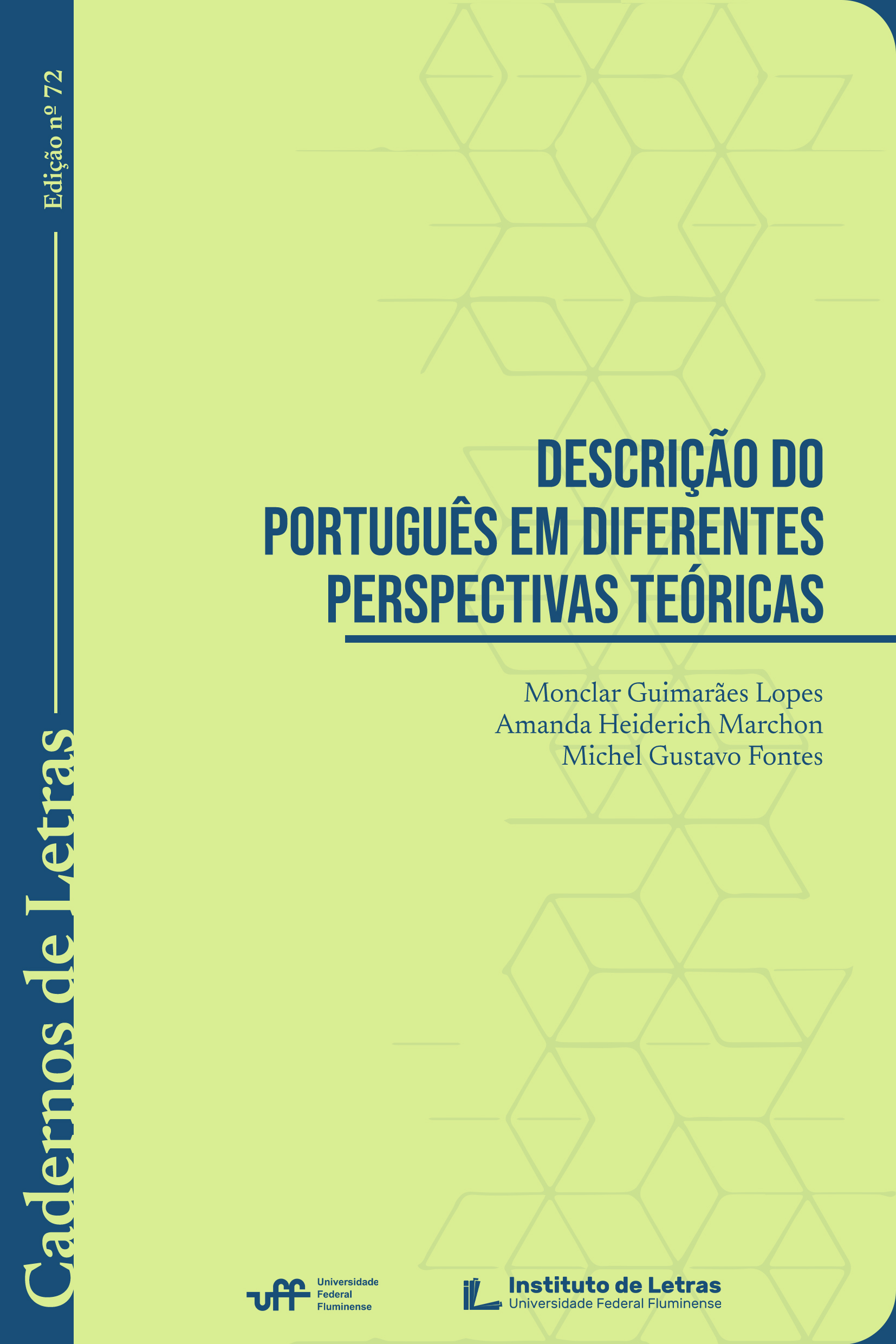
Concessiveness in Portuguese: a constructional description based on the uses of ainda que
DOI:
https://doi.org/10.22409/6ws4j350Keywords:
Constructional approach, clause linking, concessivityAbstract
This article analyzes the uses of the clausal construction introduced by ainda que in contemporary Portuguese, based on the theoretical and methodological assumptions of Usage-Based Linguistics, which brings together contributions from North American Functionalism and Construction Grammar. Within this analytical framework, language is conceived as a large inventory of linguistic constructions that emerge from speakers’ actual language use. For the analysis of 180 data, the NOW (2012-2019) section of the Corpus do Português was used. Based on the adopted analytical factors, the results reveal that clauses introduced by the connective under study show preferences regarding their position in the sentence (preposed, interpolated, or postposed in relation to the main clause), the pragmatic-discursive context, particularly with respect to presupposition, as well as the clause’s semantics and the verbal mood that accompanies it. This analysis contributes to the description of contemporary Portuguese by revealing usage patterns and discursive preferences of the connective, offering an empirically grounded view of clausal constructions and their pragmatic functions in language use.
Downloads
Downloads
Published
Issue
Section
License
Copyright (c) 2026 Caderno de Letras da UFF

This work is licensed under a Creative Commons Attribution-NonCommercial 4.0 International License.
I authorize Cadernos de Letras da UFF to publish the paper of my authorship/responsibility that I now submit, in case it is accepted for online publication.
Moreover, I declare that this contribution is original, that it was not submitted to any other editor for publication, and I sign the present declaration attesting the truth of all its contents.
The copyright of the works published at the virtual space of the Cadernos de Letras da UFF are automatically entitled to Cadernos de Letras da UFF. Their total or partial reproduction is conditioned to the authors' citations and publication data.

Cadernos de Letras da UFF is licensed under a Creative Commons - Attribution-NonCommercial 4.0 International (CC BY-NC 4.0).