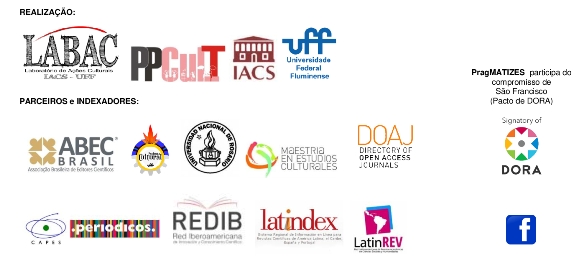
Feeling our way: mood and cultural studies
DOI:
https://doi.org/10.22409/pragmatizes.v0i10.10427Abstract
This essay is a contribution to an emergent investigation into the usefulness of “mood” as an analytic category for communication and cultural studies. In it I offer a number of descriptive moodscapes that demonstrate the way that mood can direct us to a material world of orientation, attunement, and atmosphere. I also suggest that cultural studies, as a writerly form, can also engage generatively with mood as a productive and political project.Downloads
References
ALTIERI, Charles. The Particulars of Rapture: An Aesthetic of the Affects. Ithaca, NY: Cornell University Press, 2003.
BOURDIEU, Pierre. Outline of a Theory of Practice. Cambridge: Cambridge University Press, 1977.
BRECHT, Bertold. “The Popular and the Realistic”. In: Brecht on Theatre. London: Methuen, 1964.
CERTEAU, Michel de. The Practice of Everyday Life. Berkeley: University of California Press, 1984.
FELSKI, Rita; FRAIMAN, Susan. “Introduction”, New Literary History, 43, 2012.
GUIGNON, Charles. “Moods in Heidegger’s Being and Time”. In: CALHOUN, Cheshire; SOLOMON, Robert C. [orgs.] What is an Emotion? Classic Reading in Philosophical Psychology. New York: Oxford University Press, 1984.
HEIDEGGER, Martin. Being and Time. New York: Harper Perennial, 2008.
RANCIÈRE, Jacques. The Politics of Aesthetics: The Distribution of the Sensible. London: Continuum, 2004.
Downloads
Published
Issue
Section
License
By forwarding an original to PragMATIZES, the authors agree that the copyright related to it is transferred to the Publishing. Articles and other writings are made available in PDF format from their publication, and they can be downloaded to institutional repositories and personal pages, provided that with their proper bibliographic indication.