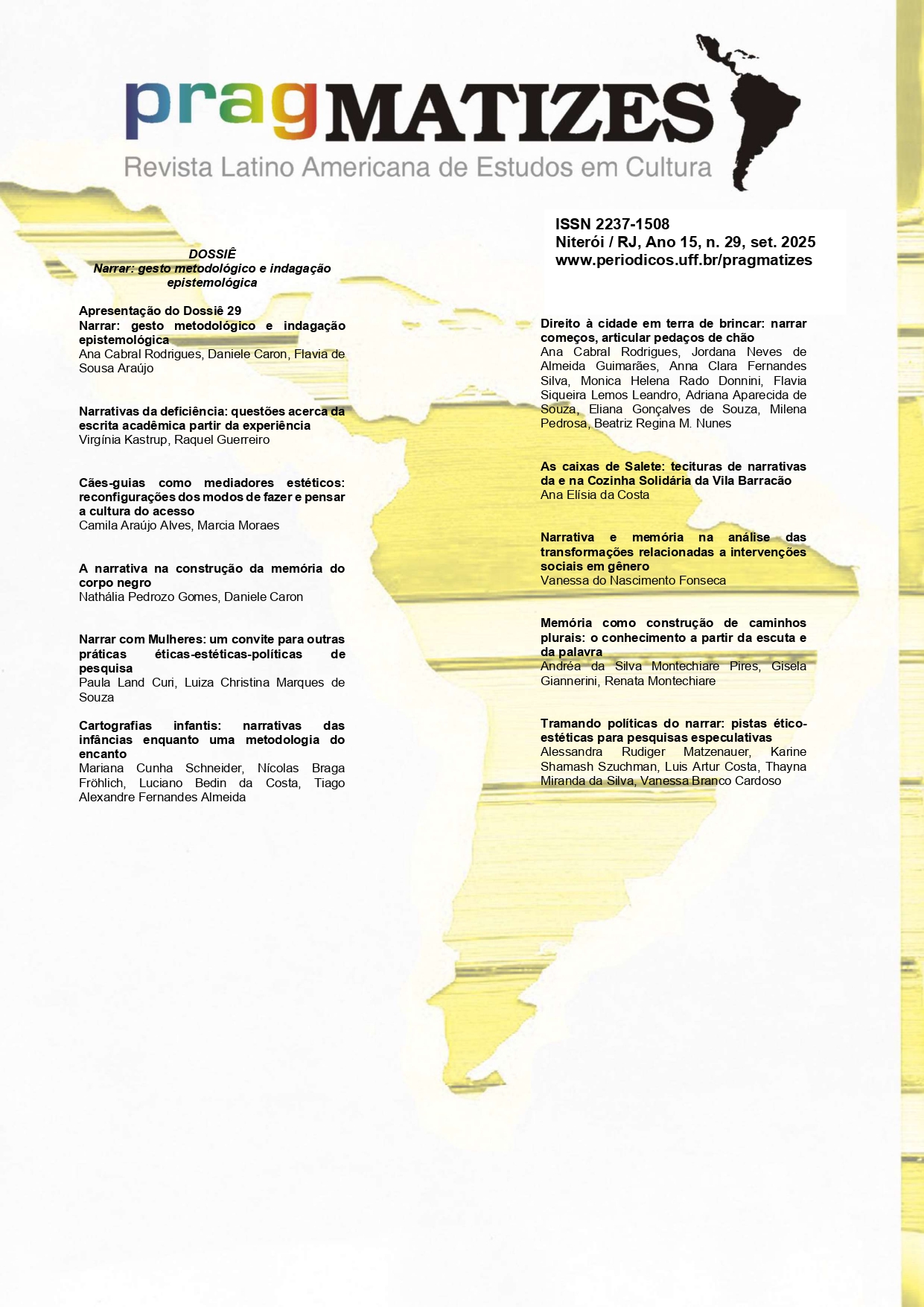
Right to the city in play territory
narrating beginnings, articulating pieces of ground
DOI:
https://doi.org/10.22409/pragmatizes.v15i29.69680Keywords:
subjectivation processes, city, narrative, childhoods, montageAbstract
This article begins with an encounter: one that arises between a university campus comprised mostly of women researchers from the Urban Disutilities Research Group (UFF-VR), who address the problematic of urban policies as policies of subjectivation from an intersectional perspective, and the ground of the Dom Waldyr Calheiros occupation, sustained by the knowledge and courage of women-leaders-mothers alongside the dreams and playful energy of artistic and crafty children, creators of culture. An encounter that arises from the daily reality and urgency of the struggle for housing and dignity in the city. Based on a policy of narrative writing by diverse voices that sometimes distinguish themselves, sometimes blend, and guided by the aesthetics of the fragment in Benjaminian montage as a method, we propose to highlight the density of the production of a common minimum as a condition of possibility for a psychology that thinks WITH territories. What can be gathered from the production of this research and extension path is the presence of an ethical-political-epistemological call for sharing the margin and decentering places of knowledge production.
Downloads
References
BAVCAR, Evgen. Le voyeur absolu. Paris: Seuil, 1992.
BELARMINO, Joana. O que percebemos quando não vemos. Fractal: Revista do Departamento de Psicologia da UFF, v. 21, n. 1, p. 179-184, 2009. Disponível em: https://periodicos.uff.br/fractal/article/view/4736. Acesso em: 09 jan. 2025.
DINIZ, Débora. O que é deficiência. São Paulo: Brasiliense, 2007.
GARLAND-THOMSON, Rosemarie. Integrating disability, transforming feminist theory. NWSA Journal, v. 14, n. 3, p. 1-32, 2002. Disponível em: https://www.jstor.org/stable/4316922. Acesso em: 10 mar. 2025.
GARLAND-THOMSON, Rosemarie. Feminist Disability Studies. Signs, v. 30, n. 2, p. 1557-1587, 2005. Disponível em: https://www.journals.uchicago.edu/doi/abs/10.1086/423352?journalCode=signs. Acesso em: 20 fev. 2025.
GAVÉRIO, Marco Antônio. Aberrações tropicais: representações da monstruosidade no teatro Latino-Americano. Áskesis, v. 9, n. 2, p. 188-192, 2020. Disponível em: https://www.revistaaskesis.ufscar.br/index.php/askesis/article/view/548. Acesso em: 15 jan. 2025.
GUERREIRO, Raquel. Cartografia, deficiência visual e arte: acompanhando o processo da acessibilidade no Centro Cultural do Banco do Brasil do Rio de Janeiro. Dissertação (Mestrado em Psicologia) – Instituto de Psicologia, Universidade Federal do Rio de Janeiro, Rio de Janeiro, 2016.
GUERREIRO, Raquel. Fazer um corpo todo de escuta: uma travessia existencial. Tese (Doutorado em Psicologia Social e Institucional) – Instituto de Psicologia, Universidade Federal do Rio Grande do Sul, Porto Alegre, 2021.
HARAWAY, Donna. Saberes localizados: a questão da ciência para o feminismo e o privilégio da perspectiva parcial. Cadernos Pagu, v. 5, p. 7-41, 1995. Disponível em: https://periodicos.sbu.unicamp.br/ojs/index.php/cadpagu/article/view/1773. Acesso em: 09 jan. 2025.
JULIEN, François. Il n’y a pas d’identité culturelle. Paris: L’Herne, 2016.
KASTRUP, Virgínia. Cegueira e Invenção: cognição, arte, pesquisa e acessibilidade. Curitiba: Editora CRV, 2018.
KASTRUP, Virgínia; POZZANA, Laura. Histórias de cegueira. Curitiba: Editora CRV, 2016.
KASTRUP, Virgínia; VALENTE, Dannyelle. How to make the body speak? Visual disability, verbalism and embodied speech. Psicologia: Ciência e Profissão, v. 38, n. 3, p. 572-583, 2018. Disponível em: https://www.scielo.br/j/pcp/a/7LKk6ZZx4Q3MPHSzLGSq9JF/abstract/?lang=pt. Acesso em: 14 fev. 2025.
KLEEGE, Georgina. More than meets the eye. What blindness brings to art. Oxford: University Press, 2018.
LEWI-DUMONT, Nathalie. Langage. Voir [barré], 38-39, p. 174-183, 2011.
MARTINS, Bruno Sena. Pesquisa acadêmica e deficiência visual: resistências situadas, saberes partilhados. Revista Benjamin Constant, v. 19, p. 55-66, 2013. Disponível em: https://revista.ibc.gov.br/index.php/BC/article/view/378. Acesso em: 09 fev. 2025.
MCRUER, Robert. Compulsory able-bodiedness and queer/disabled existence. In: HALL, Donald E. & JAGOSE, Annamarie (eds.), The Routledge Queer Studies Reader. Abingdon: Routledge. pp. 488-497, 2012.
MELLO, Anahi Guedes de. Deficiência, incapacidade e vulnerabilidade: do capacitismo ou a preeminência capacitista e biomédica do Comitê de Ética em Pesquisa da UFSC. Ciência & Saúde Coletiva, v. 21, n. 10, p. 3265-3276, 2016. Disponível em: https://www.scielo.br/j/csc/a/J959p5hgv5TYZgWbKvspRtF/abstract/?lang=pt. Acesso em: 12 jan. 2025.
MORAES, Marcia; KASTRUP, Virgínia. Exercícios de ver e não ver: arte e pesquisa com pessoas com deficiência visual. Rio de Janeiro: Nau, 2010.
MORAES, Marcia; TSALLIS, Alexandra C. Contar histórias, povoar o mundo: a escrita acadêmica e o feminino na ciência. Rev. Polis Psique, v. 6, n. especial, 2016. Disponível em: https://seer.ufrgs.br/index.php/PolisePsique/article/view/61380. Acesso em: 09 mar. 2025.
MORAES, Marcia. PesquisarCOM: permanências e reparações. In: SILVEIRA, Marília; MORAES, Marcia; QUADROS, Laura Cristina de Toledo (Orgs). PesquisarCOM: caminhos férteis para a pesquisa em psicologia. Rio de Janeiro: NAU Editora, pp. 21-42, 2022.
PASSOS, Eduardo; KASTRUP, Virgínia; ESCÓSSIA, Liliane. Pistas do método da cartografia: pesquisa-intervenção e produção de subjetividade. v. 1. Porto Alegre: Sulina, 2009.
PASSOS, Eduardo; KASTRUP, Virgínia; TEDESCO, Sílvia. Pistas do método da cartografia: a experiência da pesquisa e o plano comum. v. 2. Porto Alegre: Sulina, 2014.
RIBAS, Cristina. Feminismos bastardos, feminismos tardios. São Paulo, N-1 Edições, 2019. Série Pandemia.
RIBEIRO, Djamila. O que é lugar de fala? Belo Horizonte: Letramento, 2017. Feminismos plurais.
SILVEIRA, Marília; MORAES, Marcia; QUADROS, Laura Cristina de Toledo. PesquisarCOM: caminhos férteis para a pesquisa em psicologia. Rio de Janeiro: NAU Editora, 2022.
SIMPLICAN, Stacy Clifford. Feminist disability studies as methodology: life-writing and the abled/disabled binary. Feminist Review, v. 115, n. 1, p. 46-60, 2017. Disponível em: https://journals.sagepub.com/doi/abs/10.1057/s41305-017-0039-x. Acesso em: 12 fev. 2025.
VERINE, Bertrand. Dire le non-visuel. Approches pluridisciplinaires des discours sur les perceptions autres que la vue. Liège: Presses universitaires de Liège, 2014.
VERMERSCH, Pierre. L´entretien d´explicitation. Issy-les-Moulineaux: ESF, 2000.
VILLEY, Paul. Le Monde des Aveugles, essai de psychologie. Paris: Flammarion, 1914.
WEYGAND, Zina. Vivre sans voir. Les aveugles dans la société française, du Moyen Âge au siècle de Louis Braille. Paris: Créaphis, 2003.
Downloads
Published
Issue
Section
License

This work is licensed under a Creative Commons Attribution 4.0 International License.
By forwarding an original to PragMATIZES, the authors agree that the copyright related to it is transferred to the Publishing. Articles and other writings are made available in PDF format from their publication, and they can be downloaded to institutional repositories and personal pages, provided that with their proper bibliographic indication.