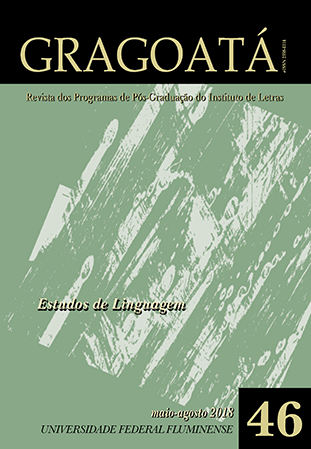
Vol. 23 No. 46 (2018): Language: cognition and uses

					View Vol. 23 No. 46 (2018): Language: cognition and uses
Four-month period: May-Aug. 2018.
Issue date: Aug. 30th, 2018.
Published: 2018-08-30

Presentation

  • Language: cognition and uses

    Eduardo Kenedy, Marta Donazzan
    347-353
    DOI: https://doi.org/10.22409/gragoata.v23i46.33580

Language Articles

  • Semantic priming effects and lexical access in English as L3

    Pâmela Freitas Pereira Toassi, Mailce Borges Mota
    354-373
    DOI: https://doi.org/10.22409/gragoata.v23i46.33581
  • Methodological control: creation of a corpus for studies on the lexical processing of bilingual and multilingual individuals

    Nalim Barbosa Pinto, Ana Beatriz Arêas da Luz Fontes
    374-404
    DOI: https://doi.org/10.22409/gragoata.v23i46.33582
  • Processing of Bare Nouns in BP: investiganting interfaces between cognitive domains

    Michele Monteiro de Souza, Cristina Name
    405-426
    DOI: https://doi.org/10.22409/gragoata.v23i46.33583
  • Psycholinguistic models of oral verbal language production

    Leonor Scliar-Cabral
    427-447
    DOI: https://doi.org/10.22409/gragoata.v23i46.33584
  • A cognitive reading of the process of non-pathological first language loss

    Felipe Flores kupske, Athany Gutierres
    448-469
    DOI: https://doi.org/10.22409/gragoata.v23i46.33585
  • Remarks on the pejorative suffix: testing the speaker’s intuition towards a phase theory in words

    Rafael Dias Minussi, Caroline da Silva Oliveira
    470-491
    DOI: https://doi.org/10.22409/gragoata.v23i46.33586
  • Small clauses in advertisements in a discursive-functional perspective

    Erotilde Goreti Pezatti
    492-517
    DOI: https://doi.org/10.22409/gragoata.v23i46.33587
  • The Preferred Argument Structure of 'unattached' Temporal Circumstantial Hypotactic Clauses in 'when memes'

    Sávio André de Souza Cavalcante, Violeta Virgínia Rodrigues
    518-543
    DOI: https://doi.org/10.22409/gragoata.v23i46.33588
  • Causal clauses and information structure of the sentence

    Patrícia Rodrigues
    544-565
    DOI: https://doi.org/10.22409/gragoata.v23i46.33589
  • When speaking becomes demanding: the construction FALAR PARA V. infinitive in Portuguese, a cognitive explanation

    Vanda Maria Cardozo de Menezes
    566-583
    DOI: https://doi.org/10.22409/gragoata.v23i46.33590
  • Polysemy in the uses of the verb 'ter': arbitrariness or iconicity? A question of point of view

    Cleiliane Sisi Peixoto
    584-608
    DOI: https://doi.org/10.22409/gragoata.v23i46.33591
  • Spatiality and metonymic processes in the song “Querência amada”

    Odair José Silva dos Santos, Heloísa Pedroso de Moraes Feltes
    609-631
    DOI: https://doi.org/10.22409/gragoata.v23i46.33592
  • The identity vitality of intonational contours typical of the "Manezinho" speech

    Izabel Christine Seara, Juan Manuel Sosa, Roberta Pires de Oliveira
    632-653
    DOI: https://doi.org/10.22409/gragoata.v23i46.33593
  • Salience in conservation of /d/ in /ndo/ segment: social and stylistic effects

    Raquel Meister Ko Freitag, Paloma Batista Cardoso, Bruno Felipe Marques Pinheiro
    654-678
    DOI: https://doi.org/10.22409/gragoata.v23i46.33594

Reviews of Language Studies books

  • Para entender: semântica, by Ana Quadros Gomes and Luciana Sanchez Mendes

    Fernanda Rosa-Silva
    679-688
    DOI: https://doi.org/10.22409/gragoata.v23i46.33595
  • Guest editores and contributors

    689-694
    DOI: https://doi.org/10.22409/gragoata.v23i46.33596
  • About this issue

    343-346
    DOI: https://doi.org/10.22409/gragoata.v23i46.33597